

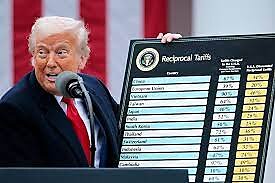

To sway opinion ahead of the Supreme Court’s examination of whether President Trump possesses authority to impose tariffs under the International Emergency Economic Powers Act (he doesn’t), the administration has framed these measures as a vital tool for revitalizing American manufacturing. Commerce Secretary Howard Lutnick, for example, has insisted that the administration’s preposterously misnamed “reciprocal” tariffs have “finally level[ed] the playing field for American manufacturers and producers,” an economic sector he claims has been “hollowed out” by a trade deficit in goods.
This narrative is wrong in both its diagnosis and proposed cure. As pointed out in the Cato Institute’s amicus brief to the court, American manufacturing is at historically high levels. Undergirded by global trade, the sector is a clear success story.
The government has justified the President’s invocation of emergency powers on the premise that tariffs are needed to reverse an alleged decline in U.S. manufacturing. Yet American industry was performing at historically high levels before IEEPA tariffs were introduced. U.S. industrial capacity is at an all-time high, and industrial production stands near its peak. Manufacturing output today is significantly higher than in decades past, and U.S. manufacturing value-added—an indicator of the sector’s contribution to GDP—has reached record levels. Similarly, U.S. exports of manufactured goods achieved a new record last year. These indicators make clear that manufacturing was not in crisis.
The numbers speak for themselves.
A sector with record amounts of value-added, exports, and capacity may be many things, but “hollowed out” isn’t among them. There was no emergency to be fixed. More accurately, American manufacturing is thriving (or at least it was when President Trump began his second term).
But even if manufacturing were struggling, Trump’s tariffs would be the wrong solution. Although individual firms may benefit from raising the cost of competing imported products, the aggregate impact of tariffs on manufacturers is clearly deleterious.
As explained in the Cato Institute’s amicus brief:
Far from supporting domestic manufacturers, tariffs often harm them by increasing production costs. According to the National Association of Manufacturers, 56 percent of all U.S. imports last year were inputs used by manufacturers. Tariffs raise the price of these goods and their domestic equivalents. Multinational corporations and advanced manufacturers are especially vulnerable, as they typically have complex global supply chains that cannot be easily onshored and/or depend on access to high-quality, cost-effective components from around the world.
Tariff costs aren’t the only problem. Constant policy shifts inject harmful uncertainty into business planning. When trade rules can change overnight by executive proclamation, companies delay investment and hedge production decisions as greater uncertainty clouds the business outlook.
A conversation I had with a bicycle company CEO earlier this year captures the difficulty of operating under an erratic tariff policy:
…Powell noted that tariffs aren’t his only problem. His company also has to contend with the erratic nature of U.S. trade policy under Trump, in which tariffs are announced but then paused. And then raised. Perhaps they are just bargaining chips as part of a negotiation … or not. Long-term planning, he explained, is nearly impossible in such an environment.
“Can I move to a country or not?” he asked. “How do I know which countries will receive lower tariffs and which ones won’t? If I leave China and my choices are Poland, Portugal, Vietnam, and Cambodia, which one do I pick?”
Compliance costs compound matters. A unique set of rates for each product from each country, along with numerous product exemptions, makes following the rules a challenging task. Earlier this year, the Federal Reserve estimated that complying with Trump’s tariffs alone now costs US firms between $39 billion and $71 billion annually. Those are resources that could otherwise fund new equipment, worker training, and expansion.
Given such costly complications, it’s no surprise that a survey by the Federal Reserve Bank of Dallas found that more than 70 percent of manufacturers had experienced a negative impact from tariffs. Only 2 percent of firms reported any positive effect. Trump’s tariffs have produced not a manufacturing renaissance but industry-wide harm.
Administration talk of using tariffs to reinvigorate or rescue manufacturing is divorced from reality and sharply at odds with the evidence. Rather than imperiling American manufacturing, a Supreme Court ruling against President Trump’s ability to impose tariffs under the IEEPA would bolster American industry—and the rule of law.