

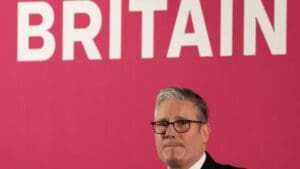
Prime Minister Keir Starmer has denied accusations that Chancellor Rachel Reeves misled the cabinet or the public over the state of the public finances ahead of last week’s Budget, after a fresh row erupted between the Treasury and the Office for Budget Responsibility (OBR).
Speaking at a nursery in London, Starmer defended Reeves’ tax rises and her decision to scrap the two-child benefit cap, despite weeks of speculation over possible income tax hikes. He insisted that revenue-raising measures were unavoidable and dismissed allegations that the government exaggerated the scale of its fiscal challenges.

“There was no misleading,” he said. “It was inevitable we would always have to raise revenue. I was clear we needed more headroom.”
His comments follow criticism of the Treasury’s pre-Budget handling after Reeves repeatedly signalled that income tax rates might be raised — a position later abandoned. Reports suggested the Treasury believed there was a £30bn shortfall in fiscal headroom, a figure now disputed by the OBR.
In a letter to the Treasury Select Committee, OBR chair Richard Hughes confirmed that there was no significant deterioration in the public finances after 20 October, aside from the government’s decision to ditch planned welfare cuts. That assessment contradicts claims circulating in early November that the UK faced a much deeper fiscal hole.
Further questions have arisen about the timing of Reeves’ statements. On 5 November, she implied Labour was prepared to break its manifesto pledge on income tax. By 13 November, media briefings claimed tax rises had been shelved due to improved forecasts. The OBR has since confirmed no such improvement occurred in that period.
The BBC’s political editor, Chris Mason, said on Monday that the Treasury had “misled the public” by allowing speculation to build on inaccurate or incomplete information.
Starmer rejected the accusation, pointing instead to the OBR’s productivity review, which downgraded trend growth forecasts and forced the government to raise additional revenue. He said he was “bemused” that the OBR had not revised these figures before the General Election.
“I’m not angry at the productivity review,” he said. “It’s a good thing to do them from time to time.”
He added that the OBR remained “vital and integral” to maintaining financial stability.
Hughes is due to appear before MPs on Tuesday in what is expected to be a tense hearing between the OBR and the Treasury.
Starmer’s remarks came during a speech outlining the government’s next phase of its economic growth agenda. He identified three priorities — deregulation, welfare reform, and boosting trade ties — as central to raising living standards.
He also appeared to confirm that the government will back all recommendations from economist John Fingleton’s review of the nuclear sector. The review found that a planning system dominated by “process over outcomes” had made the UK the costliest place in the world to build nuclear power plants.
“I am accepting the Fingleton recommendations,” Starmer said, with business secretary Peter Kyle instructed to extend reforms across other sectors.
“Today represents the biggest, most radical change to nuclear regulation in our country’s history,” said Lawrence Newport of Looking for Growth. “These reforms will transform our energy sector, allowing us to make more energy here and reduce bills for households and businesses.”
Read more:
Starmer rejects claims government misled public as tensions with OBR escalate